Minaret of Jam
Afghanistan UNESCO World Heritage Site
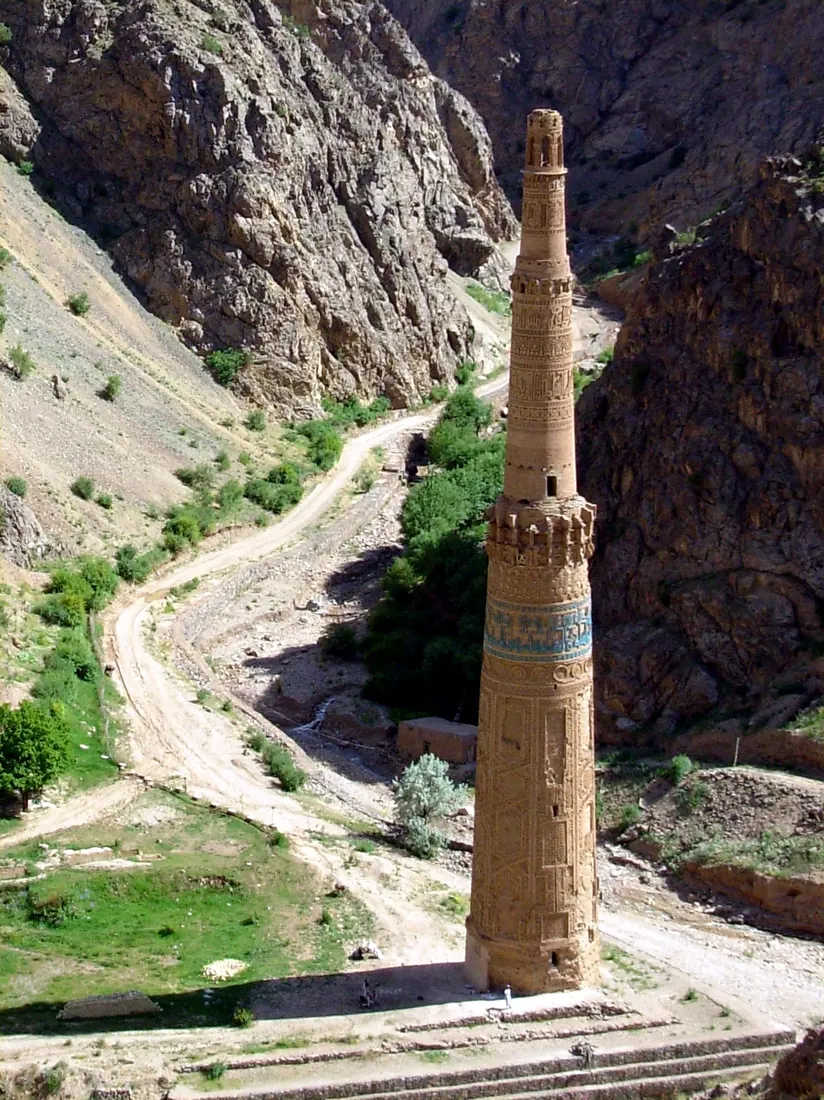
The Minaret of Jam is a 65-meter tall brick structure commissioned by Ghiyath al-Din Muhammad in 1194. It serves as an archaeological site and is recognized as part of a UNESCO World Heritage site. It is one of the most significant historical landmarks in the region, ranking as the 3rd most looked-up sight in Afghanistan on English Wikipedia.
Planning a visit
The climate in the Shahrak District varies significantly throughout the year. Winters are harsh and cold, with temperatures in January and February ranging from highs of -3 °C to -2 °C down to lows of -15 °C and -14 °C. Precipitation is also more frequent during the colder months. Travelers may find the summer months of June, July, August, and September more suitable for a visit. During this period, the weather is milder, with daily highs reaching 24 °C to 25 °C, and there is almost no rainfall. The site is located 211 km from the nearest airport, Herat - Khwaja Abdullah Ansari International Airport in Guzara. It is 427 km from Kabul. The minaret itself is part of the broader Minaret and Archaeological Remains of Jam, which encompasses an area of 6 square kilometers.
Weather by month
The warmest month is July, with an average high of 25 °C. The wettest is March, with about 82 mm of rain.
| Jan | Feb | Mar | Apr | May | Jun | Jul | Aug | Sep | Oct | Nov | Dec | |
|---|---|---|---|---|---|---|---|---|---|---|---|---|
| Average high, °C | -3 | -2 | 5 | 14 | 20 | 24 | 25 | 25 | 22 | 17 | 11 | 3 |
| Average low, °C | -15 | -14 | -7 | 0 | 6 | 8 | 10 | 9 | 6 | 3 | -2 | -9 |
| Rainfall, mm | 55 | 64 | 82 | 66 | 42 | 7 | 2 | 1 | 3 | 10 | 25 | 40 |
| Rainy days | 7 | 7 | 8 | 5 | 3 | 0 | 0 | 0 | 0 | 1 | 6 | 4 |
Temperatures and rainfall: 1981–2010 averages for this spot (4 km grid), from CHELSA. Rainy days: 2015–2024, NASA POWER.