Mount Everest
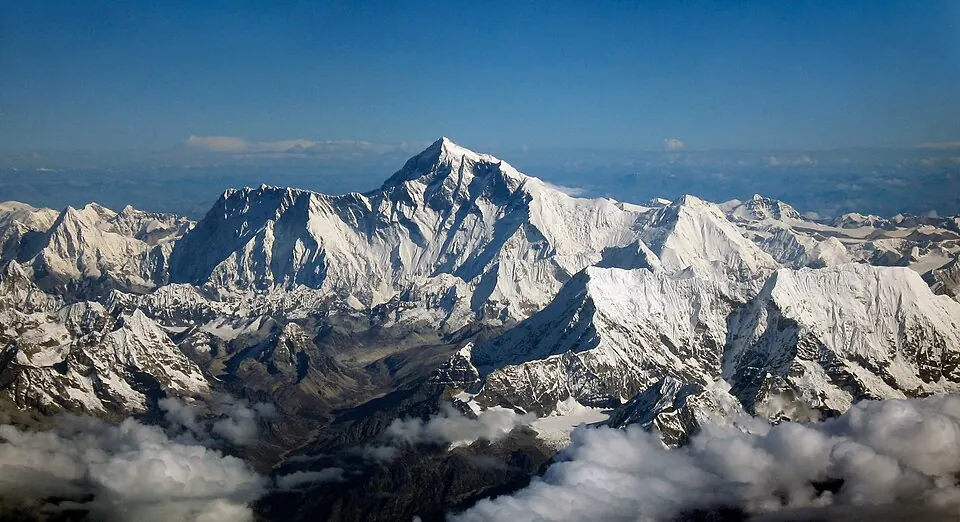
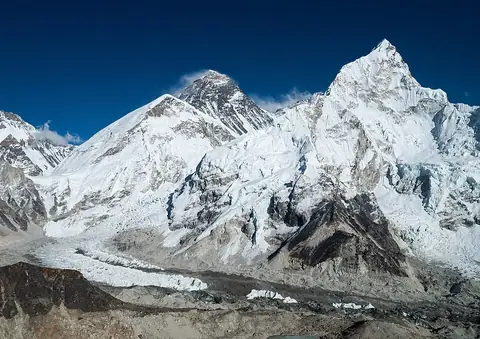
Mount Everest is a mountain located in the Mahalangur Himal range of the Himalayas. It is an eight-thousander and part of the Seven Summits, reaching an elevation of 8849 meters. As one of the most looked-up sights in Nepal, it is known for its composition of rock and ice.
Planning a visit
Temperatures on Mount Everest remain below freezing throughout the entire year. The coldest conditions occur in January and February, when highs reach only -30 °C and -29 °C, respectively, with lows dropping to -40 °C. While the summer months of June, July, and August are the warmest, with highs of -8 °C to -9 °C, they are also the wettest, with up to 28 rainy days. November is a relatively dry option with only 15 mm of rain and no significant rainy days, though temperatures are cold, with a high of -23 °C.
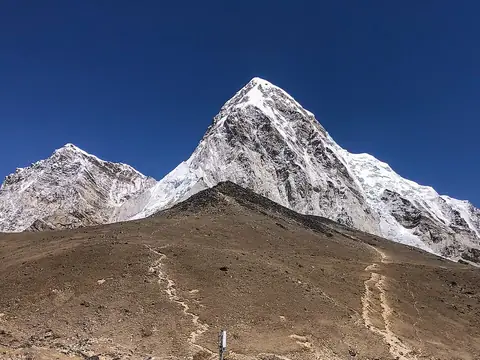
To reach the mountain, travelers typically fly into Tenzing-Hillary Airport in Lukla, which is 39 km away. The major hub for the region is Tribhuvan International Airport in Kathmandu, located 157 km from the mountain and 161 km from the capital. Once in the area, visitors often combine their trip with a visit to the nearby peak of Kala Patthar, situated 9.5 km away, or spend time in Sagarmatha National Park, which is 25.2 km from the site.
Weather by month
The warmest month is August, with an average high of -8 °C. The wettest is July, with about 561 mm of rain.
| Jan | Feb | Mar | Apr | May | Jun | Jul | Aug | Sep | Oct | Nov | Dec | |
|---|---|---|---|---|---|---|---|---|---|---|---|---|
| Average high, °C | -30 | -29 | -26 | -21 | -14 | -9 | -8 | -8 | -11 | -17 | -23 | -26 |
| Average low, °C | -40 | -40 | -37 | -31 | -24 | -16 | -13 | -14 | -17 | -27 | -33 | -37 |
| Rainfall, mm | 34 | 51 | 60 | 85 | 149 | 338 | 561 | 552 | 338 | 75 | 15 | 16 |
| Rainy days | 1 | 2 | 7 | 12 | 18 | 22 | 28 | 28 | 21 | 6 | 0 | 1 |
Temperatures and rainfall: 1981–2010 averages for this spot (4 km grid), from CHELSA. Rainy days: 2015–2024, NASA POWER.